


Harassment and Sexual Misconduct Central Single Source of Information
Bishop Auckland College is committed to protecting all students and staff from harassment and sexual misconduct.
Any form of harassment or sexual misconduct is unacceptable and the College has robust policies and procedures in place to prevent and address harassment and sexual misconduct.
This page is our single comprehensive source of information (CSI) for any information you may need in relation to harassment and sexual misconduct, including how to report an incident and how to find support.
Please see our:
| Student policies | Staff policies |
What is Harassment, Sexual Harassment, Sexual Violence and Sexual Misconduct?
Harassment may be directed at an individual or a group. Under the Equality Act 2010, harassment is defined as “unwanted conduct related to a relevant protected characteristic, which has the purpose or effect of violating an individual’s dignity, or creating an intimidating, hostile, degrading, humiliating or offensive environment for that individual.
Sexual Harassment is unwanted conduct of a sexual nature, that can occur online and offline, that has the purpose or effect of violating a person’s dignity, or creating an intimidating, hostile, degrading, humiliating or offensive environment
Sexual Violence refers to sexual acts carried out without consent and includes rape, sexual assault, assault by penetration, and other forms of sexual offending.
Sexual misconduct is any unwanted or attempted unwanted conduct of a sexual nature. This includes, but is not limited to, sexual harassment, sexual assault and rape.
Examples include such as:
Unwanted sexual comments or advances
Unwanted touching or groping
Sexual coercion
Sharing intimate images without consent
Sexual assault or rape
Consent
A person consents if they agree by choice and have the freedom and capacity to make that choice. (Sexual Offences Act 2003, Section 74).
Reporting & Support at Bishop Auckland College
If you have experienced harassment, bullying or sexual misconduct, our safeguarding team or student services team are available on-site to speak to you or signpost you to further support if needed.
For students at Bishop Auckland College Campus, please contact:
Cheryl Hird (Safeguarding Mental Health Coordinator) via reception or @ safeguarding@bacoll.ac.uk
Or Lisa Campbell – Executive Director of People/ Designated Safeguarding Lead via reception or safeguarding@bacoll.ac.uk
In addition, there is a duty safeguarding officer who is available whenever the college/SWDT is open who is a duty safeguarding officer and is available to help.
For staff
Lisa Campbell – Executive Director of People/Designated Safeguarding Lead @lisa.campbell@bacoll.ac.uk
Katie Davies – HR Coordinator@katie.davies@bacoll.ac.uk
Anonymous reporting
You can also use our anonymous reporting tool:
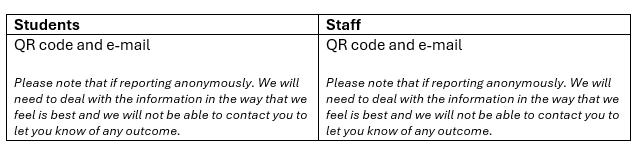
QR Code for Students
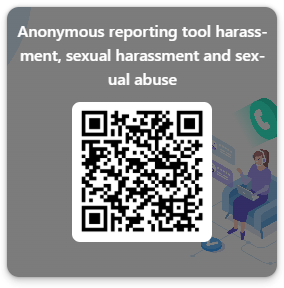
Anonymous reporting tool harassment, sexual harassment and sexual abuse – Fill out form
QR Code for Staff

Confidential staff sexual harassment reporting tool – Fill out form
The information you disclose does not begin a formal process, but you may be contacted to establish whether you would like us to initiate this process on your behalf using the information you provide.
We will not disclose any personal or identifiable information to external organisations unless we believe there is a genuine threat to a person’s health and safety.
The support you receive is collaborative, holistic and grounded in consent. Notes from conversations will be stored securely and will only be shared with those who need to know.
Any reports of sexual harassment and misconduct involving students will be overseen by Student Services. Reports relating to staff conduct will be handled by Human Resources.
Relationships between staff and students
Staff and student intimate personal relationships are considered an abuse of power and are forbidden under our existing HR policies and staff code of conduct. All pre-existing relationships must be disclosed in accordance with our HR policies.
If you have a concern about intimate personal relationships between staff and students, please contact the Principal/CEO or Designated Safeguarding Lead.
External Support if you have experienced Sexual Harassment, Assault or Violence
- The NHS offers advice on a range of different support options depending on your circumstances. Read NHS advice after rape and sexual assault
- If you are thinking of reporting to the Police, you can call 999 in the event of an emergency or if you are in danger. Please call 101 for non-emergencies if you are not in immediate danger. You can also visit your local police station to report a crime or report online. Report a crime to Durham Constabulary.
-
The Rape and Sexual Abuse Counselling Centre (RSACC) offers free, safe support to anyone in Darlington and County Durham who has experienced any form of sexual violence at any time in their lives. Access support from RSACC.
- If you wish to make an anonymous crime report, you can do so through Crimestoppers, an independent UK charity taking crime information anonymously. Report a crime anonymously through Crimestoppers
- The Maggie Oliver Foundation offers support and advice to survivors of childhood sexual abuse and exploitation through emotional support and legal advocacy. Access support from The Maggie Oliver Foundation
-
Wear Valley Women’s Aid can offer support if you have been a victim of domestic abuse, including sexual abuse, within a relationship. Access support from Wear Valley Women’s Aid.
- If you want to access free, confidential and independent advice that is fully accessible, Victim Support is here to help. Access support from Victim Support
- If you have been a victim of intimate image abuse, deepfakes, sextortion or voyeurism, the Revenge Porn Helpline can help. Get support from the Revenge Porn Helpline.
Support for Men
-
The Rape and Sexual Abuse Counselling Centre (RSACC) offers free, safe support to anyone in Darlington and County Durham who has experienced any form of sexual violence at any time in their lives. Access support from RSACC.
- The Maggie Oliver Foundation provides support for men (18+) who have experienced any form of sexual violence in their past or as an adult. Access support for men from The Maggie Oliver Foundation
- Andy’s Mans Club is an organisation which allows men to talk openly about their issues, no matter what they are. Find support from ANDYSMANCLUB.
Self-help and Support Resources for Supporting Others
These resources may help you if you are supporting someone else or if you would prefer to access self-help resources after being affected by sexual harassment and misconduct.
Academic Support
Support if experiencing Sexual Harassment in the Workplace
If you have experienced sexual harassment in the workplace, the following resources may be useful:
- Learn about sexual harassment at work from Acas
- Read the Equality and Human Rights Commission technical guidance on sexual harassment at work.
LGBTQ+ Support
-
Galop supports LGBTQ+ people who have experienced abuse and violence. Access support from Galop for LGBTQ+ people affected by abuse and violence
-
The LGBT Foundation offers a wide range of support options, including domestic abuse and sexual violence support for members of the LGBTQ+ community. Access support from the LGBT Foundation
Partner Institutions’ Sources of Information
Training for students and staff
All students will be made aware of relevant policies and procedures related to harassment and sexual misconduct during their induction
All students will be made aware of harassment, sexual misconduct, expectations and support during their induction
HE students will complete training during their induction
All staff and students will be made aware of the Single Comprehensive Source of Information (CSI)
All staff will be expected to complete training in harassment and sexual misconduct
Throughout the year additional training, awareness sessions and specialist training will be made available to staff and students.